HO Scale Main Layout
The NWV HO Main Layout is expanding!
Click on the following links to follow the progress on the NWV’s HO layout expansion:
Progress Photos from the Layout Expansion
Original Expansion Presentation – February 2023
Proposed Expansion Track Plan – February 2023
Progress Update Presentation – April 2024
Progress Update Presentation – July 2024
Progress Update Presentation – October 2024
Progress Update Presentation – January 2025
Progress Update Presentation – April 2025
Progress Update Presentation – Bridgeport – April 2025
Plainfield Scenery Upgrade YouTube Video – April 2025
Progress Update Presentation – July 2025
Progress Update Presentation – October 2025
Progress Update Presentation – January 2026
————————————————————————————
The layout is the core of the NWV. This is where we really learn from building a layout and operating model trains like on a real railroad. This is the art of model railroading and it’s the most fun to boot!
The current NWV layout is represented in our latest track plan:
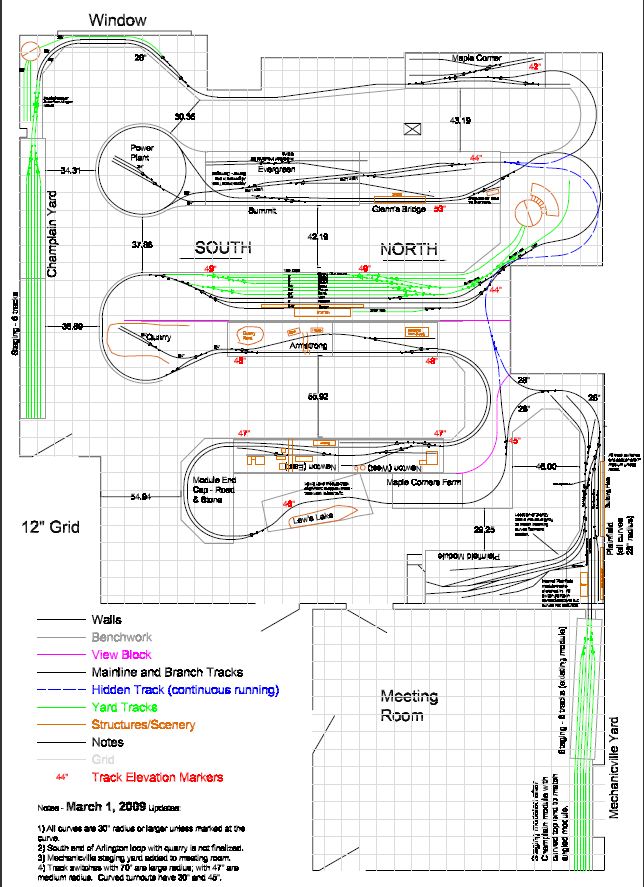
The NWV is a fictitious railroad that operates along the western side of Vermont in the early 1970’s. Its track runs north/south with terminals at Mechanicville (NY) and Champlain (Montreal, QC). The towns along the main line have fictitious names, representing towns in Vermont served by the railroad. The main division point and NWV yard is located at Arlington, midway between the Mechanicville and Champlain staging tracks at the ends.
The railroad operates with waybills to direct the movement of cars. Trains originate at either staging yard and pass through the layout, stopping at each of four towns with switch crews and Arlington Yard. The documents describing the operating sessions are located in the Operations section of this web site.
Crews are assigned to the local switchers, Arlington Yard and the through freights that pass through the layout during operations. In addition, there are two transfer freights into and out of Arlington Yard. The Central Vermont transfer comes from the CV yard in St. Albans (located in Champlain staging tracks) and the Boston and Maine transfer comes from the B&M yard in East Deerfield (located in Mechanicville staging tracks). A dispatcher manages the traffic on the layout during operating sessions.
During the pandemic, operating sessions were dropped when the State of Vermont banned gatherings of people from different families. An operating plan was devised to allow operating sessions to continue with a single person operating the layout. That method is also documented in the Operations section of this web site.
Arlington Yard Expansion Project
Arlington Yard as it was originally built for this layout was a bit of a bottle neck because there was only a single track freight mainline passing through the yard. This required, in many situations, the use of the passenger station tracks for holding freights arriving and departing Arlington Yard.
In October 2016, a modest but significant expansion was done to add a double track mainline for freights arriving in Arlington. Because there was space for another track between the existing freight main and the passenger station, another track could be added without having to relocate the existing yard tracks. In addition, a drill track was was added to the south end of the yard so that cars could be switched at that end of the yard without having to foul the mainline into the yard. In order to integrate thise new track, a new switch ladder was added to connect the existing mainline to the new track network. There was a realignment of the mainline into the yard to make space for the new drill track and to connect to the new switch ladder.
More about this project can be seen by clicking on this HO Main Layout – Arlington Expansion link. The new tracks have really streamlined operations in the yard and allow for two freights to be served simultaneously, while through freights may still pass through the yard on the station track closest to the yard, if that track is available.
Earlier NWV Layout
Our previous layout (prior to 2008) in the basement of our building was somewhat larger than the current version, with staging beneath the layout. Some historical photos of that layout can be seen in the Photos Gallery.
 NWV Model Railroad Association